Why is there a UN peacekeeping force on Cyprus?
As the Greek Cypriots took an axe to peace, and loss of life mounted, the signs of an impending regional escalation were clear. Enter the UN...
21 August 2021 (Edited) (Originally posted on Cyprium News. See the original article here.)
Mustafa Niyazi
MPhil International Relations
Founder & Chief Editor of Cyprus Profile
A ceremony with 226 United Nations (UN) peacekeepers being honoured for their service to the UN's stated cause of "peace in Cyprus" at the United Nations Peacekeeping Force in Cyprus (UNFICYP) Summer Medal Parade on Thursday 7 July 2024. The ceremony took place at the Old Lefkoşa (Nicosia) Airport in the UN Protected Area (UNPA). The newly appointed Special Representative of Secretary General (SRSG) and Head of Mission, Ms. Elizabeth Spehar praised the UN peacekeepers and paid special tribute to UNFICYP’s departing Force Commander, Major General Kristin Lund, who was due to complete her assignment in Cyprus. Also speaking at the event was the UN Secretary-General’s Special Adviser on Cyprus (SASG), Mr. Espen Barth Eide. UNFICYP Medals, first introduced in 1964 to recognize a minimum of 90 days duty in Cyprus, were awarded to the UN peacekeepers from Argentina, Chile, Hungary, Ukraine, Serbia, Slovakia and the UK. Image Source: Peacekeepers honoured at UNFICYP’s 2016 Summer Medal Parade | Flickr.
The United Nations (UN) has a history of establishing peacekeeping missions purposed to help countries navigate the difficult path from conflict to peace.
Historically speaking, peacekeeping by the UN has been a role of the UN's Department of Peace Operations and an "instrument developed by the organization as a way to help countries torn by conflict to create the conditions for lasting peace".
The need for such peacekeeping missions in some parts of the world leaves absolutely no room for contention. And it provides many states with a platform through which to exercise their very natural desire - or interests - that conflicts are either stopped, or at worst frozen, as well as, from time to time, to allow them to project their own power through the presence of a third party, in this case the UN, which in turn would protect their own national security interests.
There are many questions one might ask about why the UN has a presence on Cyprus in particular, though, and one common question could be what happened on Cyprus for them to even be there, or where - or what even - is Cyprus? This last one is the more popular go to for most, not everyone knows Cyprus let alone much about it, where it is, what it is, especially those not in the specific circles to need-to-know.
For this jewel in the heart of the TürkMed (a collapsed form of the term: "Turkish Mediterranean", meaning the Turkish areas of the Eastern Mediterranean), or the Green Island as it's lovingly known, is a rhapsodically storied island wrapped in as much beauty, and history, and geopolitical significance as it is in conflict, ambiguity, and the consciously self-imposed shackles of benighted intellectual corruption.
Yet it is not-so-much hidden for its strategic importance and vast resource wealth as it is actually just ignored or isolated.
So why did the UN establish a peace-keeping and peace-finding mission on Cyprus? Who - or more crucially what - mandates their presence, who makes up its forces, maintains them, pays them, and what is their intended or described cause vis-a-vis what they actually do?
The best way to start answering this is by looking at the mission itself, but more importantly, doing so through the lens of the actual people living on the island.
A team working under the Mission’s Field Technology Section of the United Nations Peacekeeping Force in Cyprus (UNFICYP) digitising approximately 1,500,000 pages of substantive political, military and police physical archives which have accumulated since the inception of the Mission almost 60 years ago. Image Source: UNFICYP | United Nations Peacekeeping Force in Cyprus (unmissions.org) As of writing this article, 600 box files of UNFICYP’s historical paper archive stored at the headquarters for decades are in the final stages of being digitised, a project which started 18 months ago and is paramount in facilitating the support of the mission to continue its mandated activities. The project is also a leap towards modernising the mission’s operations and providing easy access to its archives.
The UNFICYP, A Brief History
The United Nations Peacekeeping Force in Cyprus (UNFICYP) was set up in the first quarter of 1964, making it one of the longest-running UN Peacekeeping missions.
It was set up following the sudden, violent and illegal seizure of power by Greek and Greek Cypriot forces in 1963, and through the consent of the Republic of Cyprus (ROC) government, as was recognised then by the Turkish Cypriots under great duress, with the mission, if you believe the wording, to prevent further conflict between the Greek and Turkish Cypriot people and to bring about a return to "normal conditions".
The mission’s responsibilities expanded in 1974, following another invasion and coup d’etat by more elements favouring union with Greece, and the ensuing acceleration of attempts to liquidate the Turkish Cypriot "problem", namely, by exterminating them, and a subsequent military intervention by Türkiye, whose troops liberated the northern part of the island from Greek control and placed it squarely in Turkish Cypriot hands.
The UNFICYP’s Chief of Mission has traditionally served as the Secretary-General’s Special Representative in Cyprus and in that capacity takes the center in efforts to assist the parties in reaching a comprehensive settlement to the Cyprus Problem, the ongoing dispute between the Greek and Turkish Cypriot people.
The UNFICYP has also provided humanitarian assistance, such as during the brutal assaults against the Turkish Cypriots between 1963-1974, which led to their mass displacement and forced exodus into isolated enclaves, including refugee camps tattered with makeshift sheds and tents, world war two style grottos and even caves in the mountains, basically anywhere they could find safety. The UNFICYP also provided assistance to the Greek Cypriots after the summer of 1974.
And the UNFICYP has, most importantly, maintained a buffer zone between the Turkish and Turkish Cypriot forces in the north and the Greek and Greek Cypriot forces in the south.
With a current total of roughly 800-plus troops and 60-plus police officers, rotating and sourced from contingents of various countries, the UNFICYP has supervised the de facto ceasefire lines, which extend over 180 kilometers across the island. It has dealt with hundreds of incidents every year, including repeat incursions and violations of the buffer zone. More uniquely it does this in the absence of an actual formal ceasefire agreement, specifically because one was decisively not agreed to or signed by the Greek and Greek Cypriot forces, who simply took the various pauses to bunker down.
To those who don't know, that means this belongs the situation on the island to the category of frozen conflicts, which in international relations speak means an active armed conflict that has been brought to an end, but no peace treaty or other political framework has resolved the conflict, in particular to the satisfaction of the parties.
And both the Turkish Cypriots and Greek Cypriots understandably have opposing views to the UN's mission on the island.
Two Sides, One Story
If you ask the Greek Cypriots, they serve to legitimise the Greek position on the island and to prevent any hostility against them, whereas the unspoken fear is that they are necessary to prevent any legal and moral military intervention against their administration, which has been illegally occupying the south of the island and the internationally recognised government, though they will never acquiesce to that fact.
And to the Turkish Cypriots, who once fervently wished the UN would simply stop the wanton aggression against them, and force the Greek Cypriots to accede and accept Turkish Cypriot rights and equality, the UN instead primarily serves to continue allowing multiple flagrant violations of their fundamental rights as human beings.
Of course, the answer to who funds them is the easy part, and the islanders know too, they are paid by the Greek Cypriot administration of southern Cyprus (GCASC), which is a dependent proxy of the government of Greece, and the party illegally occupying the state of Cyprus. One third of the budget is funded by them, no doubt also ostensibly via the funding they in turn receive from other sources, such as the U.S. Agency for International Development (USAID) and European Funds (EF) programmes, all of which would also require returns in some shape or form. The government of Greece also contributes $6.5 million annually. And the rest is financed from contributions assessed on the entire membership of the United Nations, as decreed since 1993.
The answer to where it stands regarding the legal questions to the Cyprus Problem is slightly more ambiguous, especially where it does explicitly see that the Cyprus Problem is one to be solved by the actual people of Cyprus, or rather between the two parties to the island, but more importantly through the legally recognised state of Cyprus, and that it should therefore not intervene in the process, though it also has a clear mantle in facilitating cooperation and talks between the two sides.
All and sundry agree that the UN is on Cyprus for a reason, and that its presence is precipitated by what are consequentially non-negligible events.
But unpacking the events as they unfolded provides a much more shocking truth.
So why are the UN really on Cyprus?
Top Left: A Turkish property in Küçük Kaymaklı (Omorphita), burnt in the barbaric Greek attacks on the Turkish Cypriot suburb of Lefkoşa (Nicosia), who resisted, resulting in fierce fighting. Image Credits: Military Histories. Published by Malcolm Brooke on his website Military Histories with the “kind permission of Christopher Meynell”. Top Centre: Greek forces taking up positions near the Turkish Cypriot sector of Lefkoşa (Nicosia). Image Credits: Published by Malcolm Brooke on his website Military Histories with courtesy of the Pachyammos Village Museum. Top Right: A burnt out Turkish Cypriot property with the Turkish street name painted over. Image Credits: Published by Malcolm Brooke on his website Military Histories with the “kind permission of Christopher Meynell”. Bottom Left: A bulldozer converted to a tank by Greeks and used in "mopping up" operations in Küçük Kaymaklı (Omorphita). Bottom Right: A leader of the Greek community on Cyprus and EOKA (terrorist) fighter, Nikos Sampson, displaying a captured Turkish flag following their massacres of Turks in Küçük Kaymaklı (Omorphita), behind him a large group of Turkish Cypriot hostages, mostly women & children. Küçük Kaymaklı (Omorphita) was once a separate village, as shown on Kitchener's 1885 survey, before it became a satellite suburb of Lefkoşa (Nicosia).
Racism and Violence Against the Turks
The first and most prominent reason we need to pay attention to is the history of relentless violence against the Turks, with a focus on what occurred in 1963-1964, and that is controversially evidenced to have been premeditated,(1) as has been confirmed by multiple foreign observers such as Alias Kyrou, the correspondent for the Selanik (Salonika) newspaper Ellinikos Vorras,(2)(3) as well as by the evidence compiled by all the people on the ground, most prominently by the victims themselves.
Three days into what's been obfuscatedly described as "intercommunal violence" but was really an islandwide ethnic cleansing campaign, on 23 December 1963 after first denying complicity in the ongoing massacres of the defenseless Turks by Greeks armed to the teeth, the President and leader of the Greek Cypriots, Makarios III, agreed to join the Vice President and Turkish Cypriot leader, Dr. Fazıl Küçük, in making a public appeal for peace. But when it was broadcast on the radio it was followed by a statement in Greek calling upon Greek Cypriots to keep struggling for the “materialisation of our aspirations – Enosis”, destroying any chance of a perceived sincerity even.(4)
After being reapproached and ostensibly given the chance to correctly make an appropriate and explicit call for calm, at 22:00 pm Makarios once again agreed to broadcast a message, which was even more ambiguous than the first,(5) and was followed yet again by contradictions characteristic of the same insincerity as before.
On 24 December, Christmas Eve, yet another meeting took place, this time with the US Ambassador, British High Commissioner and their military attaches invited to attend. Agreements were made under great urgency and duress calling for a turn to normalcy, but the Greek Cypriots, intent on continuing, made no effort to implement them.(6)
Eventually, despite the precariousness of the situation what with Greece being the perpetrator and Britain being reluctant… but the Turkish government stepped in and appealed to the governments of Great Britain and Greece, the other two guarantor powers, to make a common effort to restore peace on the island. As a result, on 24 December the three governments issued a joint statement offering their good offices to the two communities. This appeal was repeated on the 25th. Both were ignored.
For added emphasis, Türkiye sent three jet planes to buzz the capital Lefkoşa (Nicosia) in warning flights and the 650-man-strong Turkish contingent of the Tripartite Force was ordered to leave its barracks at Wayne’s Keep and settle down at strategic points along the Girne (Kyrenia) road north of the capital.
At last, on 26 December, Makarios, fearing unilateral Turkish intervention, relented, but only enough that he could prevent it from happening, while also continuing and expanding upon his gains. He reluctantly accepted a ceasefire and the offer of the guarantor states. And it was agreed that a mixed peacekeeping force would be established by the guarantor powers, to be led by Major General Peter George Francis Young, as the Commander of the new Truce Force.
Left: Major General Peter George Francis Young, CB, CBE (15 July 1912 – 4 November 1976). He was a senior British Army officer who served in the Second World War and after being posted to the War Office in 1961, he then became General Officer Commanding Cyprus District in 1962. At the original ceasefire in 1964 Young drew a line on a map with a blunt green chinagraph pencil identifying the truce line between the Greek and Turkish Cypriot communities. It became known internationally as the Green Line. Centre: Air Chief Marshal Sir Denis Barnett (Commander in Chief Near East Air Force and Commander British Forces Cyprus). Right: British Secretary of State for Commonwealth Relations, Duncan Sandys. They were the three senior members of the Political Liaison Committee (PLC). Other participants in the committee were the British High Commissioner, the Ambassadors of Greece and Turkey, delegations from both Greek and Turkish Cypriots, the Commanding Officers of the Greek and Turkish National Contingents and Colonel John Sale, Defence Advisor at the British High Commission Major General Young's staff (including his Intelligence Officer and ADC) waited next door at the Tac HQ - the passport office.
From Isolated to Global Emergency
On 26 December, Makarios asked for an emergency meeting of the UN Security Council (UNSC) where he accused Türkiye of having committed acts of aggression against the state he was now occupying,(7) and the Turks treated this at face value, as baseless charges, moving the meeting to an appeals process.
During these appeals, Makarios mobilised over a hundred armed irregulars and tried to dislodge the Turks at the Girne (Kyrenia) pass, while the hearings took place. But this failed.
At the actual meeting, which took place on 27 December, the Greek Cypriots could not substantiate any of their charges against Türkiye or the Turkish Cypriots. The meeting was subsequently adjourned with no action being taken. The same day the British units began streaming into Lefkoşa, and on 28 December at exactly 05:50 am the British Secretary of State for Commonwealth Relations, Duncan Sandys, also made his arrival at Lefkoşa (Nicosia) Airport.
This was quickly becoming a big military and diplomatic failure for Makarios.
At the forefront of the agreements was the formation of a political committee for the purpose of giving guidance to a joint peace-keeping force and to arrange, amongst other things, the establishment of a physical ceasefire line between the two parties.
Makarios could not easily agree to these, given they would provide the Turkish Cypriots room to breath, destroying any hope he had of crushing the Turkish Cypriot resistance swiftly. They also essentially placed the Turkish Cypriots under the protectorate of a peacekeeping force in addition to the Turkish contingent of the Tripartite Force, not to mention the actual physical separation provided by a ceasefire line, and which would act as a buffer between the Greek monolith armed to the teeth trying to squash the all but defenseless Turks, who now couldn't be dealt with as methodically as Makarios would have liked or needed.
The Political Liaison Committee (PLC) was then formally set up by Secretary Sandys after lengthy discussions with Major General Young and the local military and political leaders, and the commanders of the Greek and Turkish National Contingents were summoned to arrive at the British High Commission at exactly 09:20 am, on the morning of 29 December, where the first meeting was consequently held.
At 17:00 pm the Committee met again for another momentous and lengthy meeting, where Duncan Sandys had again made it clear there would be no rest until an agreement was signed.
At General Young's request his Intelligence Officer, Major Perrett-Young, brought and produced chinagraphs (grease pencils) from the variety of colours he had in his map case. General Young deliberately chose green to avoid blue and red for their Greek and Turkish connotations respectively, and in particular for the latter's treatment as the "enemy". Bearing in mind these factional sensitivities, and as green is usually used for marking emplacements or fortifications and minefields, this made it even less controversial. He then got to work drawing a physical separation line on a map.
During the meeting the Turks and sometimes Duncan Sandys pressed Peter Young to take on more and more, to make the separation logistically manable and demarcably capable of physically protecting the Turkish Cypriots, and he drew company and platoon goose eggs (tactical map-marking symbols for a defended locality) on the map.
The meeting continued throughout the night with only one 90 minute pause at roughly 01:00 am to allow the representatives to consult with their colleagues. Time and time again General Young's green chinagraph pencil retraced the line across the talc of his field map, only to be rubbed out and changed in direction to suit the requirements of one side or the other, until the Green Line was finally and irrevocably drawn.
The meeting finally finished at 05:00 am the following day, 30 December, and a neutral zone had been agreed upon, and the British occupied a string of posts that had already been sandbagged by the Greek Cypriots prior to the events, evidence again of the premeditated nature of the attacks.
But just like the various modes of Turkish intervention before it, this decisive and bold intervention by Britain also wouldn't have the desired effect.
Top Left: The ceasefire line (the Green Line) which was, in the main, not a physical barrier, although in certain flash points in central Lefkoşa (Nicosia) short sections of the Clemens Line were restored, the Clemens Line being a barbed wire barricade erected in the heart of Lefkoşa (Nicosia) on 30 May 1956, between the Baf (Paphos) and Mağusa (Famagusta) Gates (from west to east) and stretching through Baf (Paphos) Street, Hermes Street and Mağusa (Famagusta) Street. The Clemens Line was the first instance of physical partition on the island and had defined the route of the Green Line. It was guided along the separation of the two communities during the EOKA terrorist campaign. Image Source: A Green Line is Drawn. Militaryhistories.co.uk. Military Histories - A Green Line is Drawn. Image provided to the author of that article courtesy of the Pachyammos Village Museum located in the Dilirga (Tillyria) area just west of the Erenköy (Kokkina) exclave. Top Right: A section of the map (with explanatory annotations) showing the agreed path of the Green Line which stretched beyond the limits of the walled city both to the west and to the east. Bottom Left: Colonel John Sale, the Defence Advisor at the British High Commission giving one of his many briefings. He set up and ran their Operations Room and maintained the Alpha log. He spent a lot of time working with General Young and generally liaised between all parties. As the military man on the spot, he was the only person who knew all the Turkish, Greek and Cypriot players, plus the various Ambassadors and other military attachés. General Young, as a commander in the Bases, had a much more limited vision since the Bases in the 1960s had little contact with politicians and others in Lefkoşa (Nicosia). Bottom Right: This is the final signed agreement.
British Intervention Routed
Very soon the British peacekeeping forces realised they were well-in over their heads.
The Green Line, which although had short sections of the 1956 Clemens Line restored with new barbed wire erected in certain flash points, in the heart of the capitol Lefkoşa (Nicosia), it was by no means a physical barrier, despite it defining the physical partition of the island, and it didn't cover all the areas of the island necessary to allow the Truce Force to be effective.
They could not stop the Greek forces the island-over from attacking the isolated pockets and enclaves of Turkish Cypriot resistance, nor could they logistically keep up with the intensity or quantity of attacks taking place.
They could not intervene to defend the Turkish Cypriots when and where it mattered, and it was difficult to provide aid or protection while they were being displaced en-masse during the scattered exodus that was unfolding.
Simply put, it did little to regulate hostile or defensive movements between the two sides, and they could not be in all places at once, while Makarios, on the other hand, was able to expedite and continue ordering attacks on the isolated and defenseless Turkish Cypriot enclaves dotted around the island.
In the end, Britain had decisively had enough.
And on 2 January 1964, an agreement had been reached to hold a conference in London between Türkiye, the UK, Greece, the Turkish Cypriots, and the Greek Cypriots, and the guarantor powers and Greek-controlled Cyprus government jointly requested the UN to appoint a representative to act as UN observer on Cyprus.
Collage of photographs showing the horrifying living conditions experienced by the Turkish Cypriot refugees in the immediate aftermath of the Cyprus Catastrophe 1963-1964
Terrorists Parrying the Threat of Intervention
This was significant in many ways, but the meanings, implications and challenges would become evidently clearer as the events unfolded.
The British had already dispatched their Secretary of State for Commonwealth Relations, Duncan Sandys, to Lefkoşa (Nicosia), to act as a mediator, and done their darndest to intervene while recognising and trying to parry the issues at hand.
By tolerating the presence of British troops and by pretending to be in collaboration with peace-keeping efforts, while in reality undermining them at each and every single turn, Makarios had ably parried the bigger threat of a unilateral Turkish intervention.
As long as British troops were guarding the island it seemed highly unlikely that Türkiye would ever resort to force in an attempt to bring an end to the crisis. On the other hand, as we've already established, the British could not be everywhere at once. There were still many targets and points of strategic interest, especially in the countryside. Thus under the cover of the peace-keeping force, Makarios was able to continue his attacks on isolated pockets of Turkish Cypriot resistance.(8)
Giorgio Bocca, a correspondent of the Milan based daily newspaper, Il Giorno, reported: “Right now we are witnessing the exodus of the Turks from their villages. Thousands of people abandoning homes, lands, herd; Greek terrorism is relentless. This time, the rhetoric of the Hellenes and the busts of Plato do not suffice to cover up (this) barbaric and ferocious behaviour. At four o’clock in the afternoon, curfew is imposed on the Turkish villages. Threats, shootings and attempts at arson start as soon as it becomes dark. After the massacre of Christmas that spared neither women nor children, it is difficult to put up any resistance.”(9)
And Britain knew the involuntarily difficult position they had put themselves in.
During this period Makarios repeatedly tried to use the peace-keeping force to further his own aims. He asked General Young to assist the “legal state forces”, namely his and his deputy Yorgadjis' private armies, and the national guard, and the Greek contingents of the Tripartite force, in attacking the Turkish Cypriot enclaves. When he didn’t comply, Makarios became angry and threatened, as he always did, to abrogate the treaties.
But he had to backtrack when Secretary Sandys, in return, threatened to withdraw all British troops, and Türkiye again began to “talk ominously of intervention”.(10)
Relations between the British and Makarios deteriorated further during the weeks that followed, as British troops, with increasing frequency, rushed to help Turkish Cypriots in distress, much to Makarios' anger and frustration.(11)
NATO: A New Proposal
Already the British could no longer bare the burden, and so it was decided that a new peace-keeping force had to be organised. They called for the formation of a 10,000 man force from NATO countries. As part of these plans Britain, Türkiye, Greece, the Turkish Cypriots, and Greek Cypriots were to appoint a mutually acceptable mediator to assist in the search for a solution.
This plan was presented on 31 January 1964 and was accepted by Türkiye, the Turkish Cypriots, and ceremonially by Greece, but it was rejected by the Greek Cypriots as “totally unacceptable”. Makarios also wanted to scrap the Zurich-London Accords, which prevented him from changing the constitution at will. And a NATO force would, he felt, reinforce the status quo of legally having to accept the Turkish Cypriots as equal partners.
He instead wanted a UN peace-keeping force, for the UN was in no way committed to uphold the Zurich-London Accords and its Secretary-General, U Thant, was of the opinion that the Cyprus Problem was first and foremost a matter for the Cypriot government, which the Greek Cypriots had already occupied and hijacked circa their sudden, violent and illegal seizure of power the previous month.
And Makarios cleverly started to lean on the Russians for political, diplomatic and material support.
The British and US governments were alarmed and opposed to this, as they felt his leaning to the Russians could embroil the island in the politics of the Cold War.
This allowed Makarios to further raise tensions in the region and escalate the Cyprus Problem to the global geopolitical rivalry between the United States (US) and the Soviet Union (USSR) and their respective allies.
Passing the Torch to the UN
The Greek Cypriots used this impasse to intensify their campaign of aggression,(12)(13)(14)(15)(16)(17) while simultaneously banking on convincing the great powers to support the new status quo, that is, their monolithic Greek polity's dominance and "de jure" control of the island.
On 15 February 1964 this inexorable adamance by the Greek Cypriot administration forced Britain to give up on its NATO peacekeeping force idea and take the Cyprus Problem to the UN, joining Makarios hand-in-hand to request urgent action by the Security Council.
Then after the deliberations that followed, on 4 March 1964, the Security Council, supporting the position of the Greek Cypriot administration, as the sovereign Republic of Cyprus, pivotally granted them the responsibility for the maintenance and restoration of law and order, the implications being no measures would be enforced upon the Greek Cypriots to pressurize them to stop their violence and bloodshed. It also called for restraint, a rather meaningless gesture given the situation, and unilaterally authourised the establishment of a UN peacekeeping force under the command of the Secretary-General and ultimately subservient to the political will of the Greek occupied Cyprus government.
His gambit of escalating the Cyprus Problem to join the fray in an international conflict and manipulate the great powers to get his way had unquestionably paid off.
Makarios had scored a major diplomatic triumph.
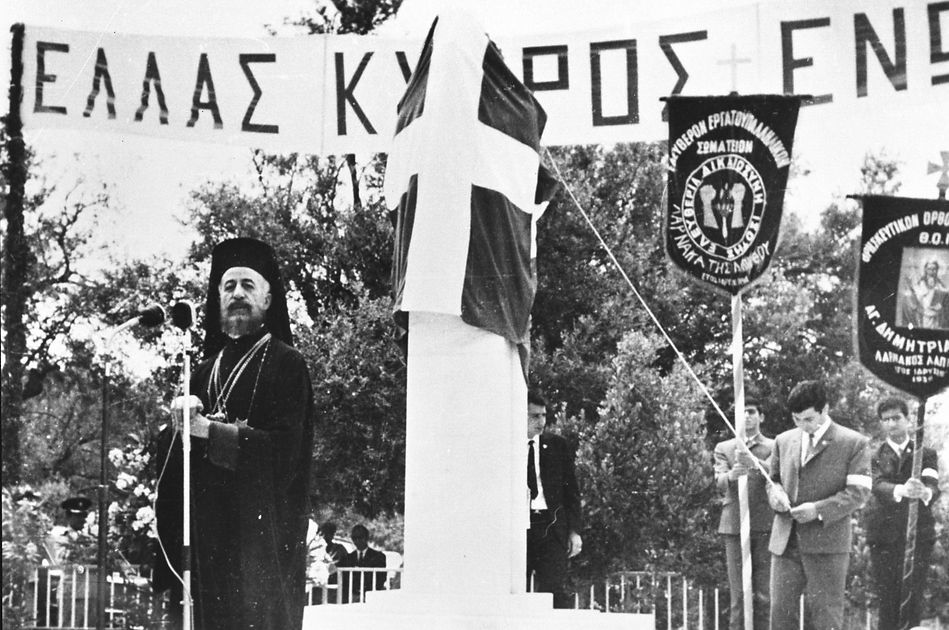
Cyprus President and Greek Cypriot leader, Michael Christodoulou Mouskos, better known by his clerical name: Archbishop Makarios III, a designated terrorist leader and accused pedophile, speaking at the opening of an EOKA monument years after their sudden, violent and illegal seizure of power in 1963-1964, known to the Turkish Cypriots as Bloody Christmas. Image Source: Greek Cypriot massacres still raw 58 years after 'Bloody Christmas' | Daily Sabah. AA Photo.
The UN: A Platform for Expediency?
During this period, Makarios took advantage of the stalemate and announced plans for the creation of a new 5,000 man Greek-officered Greek-only National Guard, to function as an auxiliary police force, in open violation of the Constitution of Cyprus.
The official purpose, Makarios reiterated, was “to disarm all Turkish Cypriots”,(18) to absorb the various private armies and other elements, such as the EOKA terrorist fighters, under his leadership, and give the Greek Cypriot irregulars, terrorists included, an official status in the hope that the UN peacekeeping force would recognise them as the only legitimate security force on the island and assist them in subduing the Turks.
And thus more offensives were also launched by the Greeks against the Turkish Cypriots to improve their position before the arrival of the UN forces.
On 6 March the Secretary-General appointed Lieutenant-General P.S. Gyani as the Commander of the new peacekeeping force and approached several potential troop-contributing governments to establish a provision of contingents.
On 9 March the situation deteriorated further, and more appeals and overtures for restraint and cessations of violence were made.
They were ignored by Makarios.
On 12 March, the government of Türkiye sent a stern message to Makarios, warning that unless the assaults on the Turkish Cypriots ceased, Türkiye would act unilaterally under the Treaty of Guarantee to send a Turkish force to Cyprus. Makarios responded by instructing their representative at the UN to request an emergency meeting of the Security Council.
On 13 March, the government of Türkiye sent a similar message to the Secretary General, stating again that unless the assaults on the Turkish Cypriots ceased, Türkiye would act unilaterally under the Treaty of Guarantee to send a Turkish force to Cyprus, adding, until the United Nations force, which should include Turkish units, effectively performed its functions. The Secretary General implored Türkiye not to take such action, and assured that the force was about to be operationally established.
On the same day, the Security Council held its emergency meeting at the request of the Greek occupied government, and adopted resolution 187 (1964), noting the Secretary-General's assurances that the force was about to be established, and pushing for resolution 186 (1964) to be implemented, and hastily bringing a Canadian contingent to the island.
On 27 March, the UNFICYP was operationally established, and the incorporation into this force of the British contingent on the island was negotiated with the British government, bringing them under UN command and thus into the thrall of the Makarios regime, therefore rendering them out of the equation.
Similar attempts were made to encourage the Turkish government to either accept the offer to put both the Greek and Turkish national contingents under UN command, though not as contingents of UNFICYP, or order its contingent to retire to its barracks.
Türkiye responded that it could agree, but put forward the condition that the Force Commander, before issuing orders to the Turkish contingent for any task or movement requiring a change in its present position, must have the prior consent of the Turkish government. This condition was not accepted by the Secretary-General, under the volition of the Greek Cypriot administration, and the two national contingents were not placed under United Nations command.
Türkiye's demand that the UNFICYP would have to include Turkish troops was also ignored.
On 4 April, emboldened by all this exception and power bestowed upon it by the UN, as well as the protection the UNFICYP essentially provided against any external military intervention especially from Türkiye, and after already having subdued the British forces and taken them into its thrall via the UNFICYP monolith, but failing to do the same to the Turkish forces, the Greek occupied government then moved to subdue or cripple the Turkish threat through other means and in different non-physical avenues.
It contended the Turkish move to leave it's camp following the Greek assaults and deploy in tactical positions astride the Girne (Kyrenia) road north of Lefkoşa (Nicosia), and unilaterally abrogated the 1960 Treaty of Alliance.
Though this had little effect in actually making the Turkish contingent leave, it gave the Makarios regime more avenues through which to attack and contain the threat of Turkish intervention.
The UN was having the intended effect.
Turkish Reaction to President Johnson's Letter to Prime Minister Inonu (Redacted). Source: Central Intelligence Agency (CIA).
Parrying Another Turkish Intervention
Months of relentless and shrieking assaults against the Turkish Cypriots followed, completely unabated, with the UN doing little beyond just observing, or providing belated after-the-fact aid, slave to the caloric restrictions imposed by the Makarios government.
The UN oftentimes found itself reacting most discernably through diplomatically worded "protests" and "complaints", such as when General Gyani protested the Greek attacks, while doing nothing to actually intervene and pressurise the Makarios regime to actually stop, or when UN Secretary General U Thant gave orders to the UNFICYP to "take more vigorous action to stop them", but just like Gyani, he did absolutely nothing to make that happen.
Attack after attack, assault after assault, massacre after massacre, the Greek Cypriots continued their genocide under the inerted watch of the UNFICYP.
One day, soaked deep in their euphoric impunity, their gambles seemed to pay off again when on 11 May they launched a vicious assault on Mağusa (Famagusta) kidnapping and shooting dead 32 Turkish Cypriots.
Only by this time the Cyprus Problem had already become too much of an existential threat for Türkiye to bare, and imperiled the very fabric of peace and stability in the region and the delicate balance of relations within the NATO itself.
The Turkish government responded as it had always done, but this time, it also made the pivotal decision to make preparations for an amphibious landing on the island.
The situation had escalated to the point where relations between Washington and Ankara also began to sour terribly, after the President of the United States, Lyndon B. Johnson, sent a bullishly blunt and undiplomatic letter to the Prime Minister of Türkiye, İsmet İnönü, threatening the Turkish government not to intervene.
And the immediate and long-term implications and meanings were clear.
The letter became the focus of heightened feelings of isolation in Türkiye, and made it almost mandatory for the country to become more independent of the United States in the field of international relations, eventually forcing it to practice its intervention anyway, after 10 years.
The letter highlighted a growing plethora of divisions among the international community, in particular, and most importantly, it got the great powers involved and divided, managed to turn the Cyprus Problem into a sticking focal point where any intervention would mean very real fears of a wider regional war between the various powers involved, and proved the effectiveness of having the UN present on Cyprus, to "justify" and allow the same to keep repeating, over and over.
Attack after attack, assault after assault, massacre after massacre, the Greek Cypriots continued their genocide under the inerted watch of the UN.
The threat of a military intervention from Türkiye had also effectively been tamed.
Makarios, through clever diplomatic planning and political chess boarding, most importantly through its cunning manipulation of the UN and its presence on the island, used the Great Powers to impose strict and binding geopolitical restraints on Türkiye, through which it essentially forced the Turks to just sit back, shut up and watch.
Until do or die, they could no more.
What This All Boils Down To…
Although on the face of it there is still some room for ambiguity surrounding the UN's presence on Cyprus, especially in the political sphere of things, but especially when it comes to the mandate upon which their physical presence as a peacekeeping force can exist, there is much less of an enigma surrounding the indispensable role it is perceived to have played in supporting the Greek Cypriot position vis-a-vis the Turkish Cypriot position.
By functionally allowing the former to continue their violations of the rule of law and legally binding obligations, as otherwise provided for and protected by multiple international treaties, a constitution and even court rulings, and treating their administration as the "government of Cyprus", albeit functionally under the doctrine of necessity, while on the other hand ostracising and attacking the Turkish Cypriot state, makes their presence and mission suspect.
It is equally not inaccurate to say that the common perception of them on the ground is that they've typically gone so far as to take sides in the dispute, such as where they allowed Greek Cypriot construction and expansion into the Buffer Zone, and to the backdrop of hundreds of other offenses and violations of the Buffer Zone by Greek Cypriots, which have all been roundly condemned by the Turkish Cypriots, while the UN did absolutely nothing about it, whereas on the flip side the UN has been incredibly quick and effective in causing an uproar and even physically intervening to prevent the Turkish Cypriot construction of humanitarian corridors linking their lands and people, even getting into scuffles with the workers and security forces, and physically attacking them.
Most controversial of all, perhaps, is the role it is perceived to have played in aiding, abetting and allowing the Greek Cypriots to continue committing acts intended to destroy, in whole or in part, an entire ethnic group or nation, as well as multiple other human rights violations, crimes against humanity and various other acts of cruelty to human beings.
At the end of the day, this is what it all boils down to.
The UN is on Cyprus because the Greek Cypriots needed them, just as they do now, in order to continue their attacks on the Turkish Cypriots, who they failed to destroy in whole and only subjugated in part, something which they are too ashamed to admit.
The entire platform upon which the Greek Cypriot administration can exist is on the back of this diplomatic triumph that they have procured legal recognition by other states as the so-called legitimate government of Cyprus, and are purportedly acting to "operate the 1960 Constitution modified to the extent dictated by the necessities of the situation".
The coercion forced onto the Turkish Cypriots to accept the presence of the UNFICYP also "legally" validates that position.
But as the UK House of Commons Select Committee conceded:
"Although the Cyprus Government now claims to have been seeking to "operate the 1960 Constitution modified to the extent dictated by the necessities of the situation", this claim ignores the fact that both before and after the events of December 1963 the Makarios Government continued to advocate the cause of ENOSIS [annexation to Greece] and actively pursued the amendment of the Constitution and the related treaties to facilitate this ultimate objective."
"Moreover in June 1967 the Greek Cypriot legislature unanimously passed a resolution in favour of ENOSIS, in blatant contravention of the 1960 Treaties and Constitution."
This is all, according to the testimonies and reporting of multiple international observers on the ground, scores of serious historians, foreign dignitaries, leaders of state, international organisations, and going by the incredibly well-documented histories of Greece and the Greek Cypriots and the events on Cyprus in general, this is all 100% accurate, but it is, unfortunately, also just another truth that has somehow been cast aside in the shadows of decades of relentless Greek Cypriot propaganda.
The fact of the matter is the UN's presence in Cyprus does not contribute to creating the conditions for peace on the island, and it does not contribute to international peace and stability. It does nothing to support the victim in this situation, the Turkish Cypriots, and acts to strictly chastise and punish them while supporting the aggressive occupiers - the Greeks - and facilitating the international isolation and suffering imposed on the Turkish Cypriots by the Greeks.
More broadly speaking, although the UNFICYP does do some good work on the island today in the humanitarian sphere of things, and the UN itself also does much around the world that is admirable and commendable, it is still, at the end of the day, as far as the Cyprus Problem is concerned, the strongest diplomatic power projection and control or subjugation tool of certain states, countries and peoples, as well as a platform for aiding and abetting the imperial foreign domination of an entire country and its people, who are deliberately excluded from the imperatives of universal rights, and to whom the importance of the speedy granting of independence and the effective guarantee and observance of human rights does not apply.
Going back to when the UN forces first arrived, they were, as Makarios had fervently wished, just like the British peacekeeping forces before them, meaning, they were unable to be everywhere at once, and the Greek Cypriots, as the aggressors, and the ones in de facto control of the internationally recognised government, they could choose their objectives at will. Moreover, the UN peacekeeping force was basically powerless. According to its mandate, it could only fire if fired upon. Its only deterrent was its presence. And it not only could not intervene but required the permission from the government, controlled by the Greek Cypriots, to even but move. As a result, Makarios was free to do as he pleased. And the same dynamic plays into the UN's presence on Cyprus today.
And the biggest elephants in the room still stand.
Public opinion.
For the Turkish Cypriots, the presence of the UN, they believe, was supposed to allow for the Greeks to end their illegal occupation of the legitimate Republic of Cyprus (ROC) government, and to accept the legally defined rights and political equality of the Turkish Cypriots, preferably through willful accord, at worst through legally enforced acquiescence, and despite promises to push this agenda and rhetoric of impartiality, they say, the UN is instead used as a weapon against them, and quite demonstrably.
For the Greek Cypriots, the presence of the UN, as they see it, is the solution to isolating the Cyprus Problem and commanding it in their favour, with the added bonus that it acts as an indispensable tool in supporting their demanded solution to the Cyprus Problem. In brevity, it allows and perpetuates their violation of domestic and international laws, otherwise enshrined in multiple international treaties and a constitution, and legitimises the status-quo of their "de jure" dominance and control.
Amidst all of this, the one and only thing that leaves no room for doubt on both sides is that the presence of the UN on Cyprus is very controversial.
But contributions to peace?
More like consciously supporting a society of terrorist supporting fanatics high on hate to implement a systemic policy of genocide and lawlessness.
And currently there is peace on the island of Cyprus.
The Turks created that peace.
They live in it. They live in freedom. And they fervently protect it. It's by no means perfect. It has a lot of issues still. They are unjustly isolated on the international stage and forced to go through involutedly cruel and punishing hardship. But they are safe. And the UN has nothing to do with that. In fact the UN, arguably together with Greece, and to varying extents the UK and the US, is constantly threatening to destroy it.
And every year the United Nations Security Council (UNSC) stands by the Greek Cypriot administration and votes to extend the mandate of the UNFICYP without consulting or seeking the permission, consent and approval of the Turkish Cypriots to operate on their island.
But it should be remembered that the main factor enabling the UNFICYP to operate within the borders of the Turkish Republic of Northern Cyprus (TRNC) in particular is the good-willed cooperation of the Turkish Cypriot authorities, despite their objections to the relevant Security Council Resolutions, and the routine reference made by the UNSC to the consent obtained from the so-called "Government of Cyprus", which in-fact is just the Greek Cypriot administration, is annually condemned by the Turkish Cypriots and openly called unacceptable.
Alas, as far as the UN is concerned, the Turkish Cypriots don't matter.
That is why there is a UN peacekeeping force on Cyprus.
*Bibliography & Reading Lists
(1) Ethnikos Kiryx, June 15, 1965 (Also quoted in Purcell, op. cit., p. 323)
(2) Purcell, op. cit., p. 323
(3) Refer to all the newspaper articles chastising the Greeks and calling their actions a shame on humanity… this is further supported by the fact international support was overwhelmingly with the Turks during this period.
(4) H. Scott Gibbons, Peace Without Honour (Ankara, 1969), p. 25
(5) Ibid, p. 34
(6) Ibid, p. 67
(7) Thomas Ehrlich, International Crises and the ROle of Law: Cyprus, 1958-1967 (London, 1974), p. 57
(8 ) The Observer. Issue of 5 January, 1964
(9) Il Giorno. Issue of 14 January, 1964
(10) Newsweek. Issue of 13 January, 1964, p. 29
(11) Newsweek. Issue of 9 March, 1964, p. 36
(12) Special News Bulletin, 20 January, 1979, p. 1
(13) Time correspondent Robert Ball witnessed an armoured Greek Cypriot assault on 6 February. Time. Issue of 14 February, 1964, p. 23
(14) On 12 February, George Ball, US Under Secretary of State, tried to persuade Makarios to accept a revised version of the British proposal for a NATO peacekeeping force formed only of people from commonwealth countries. Makarios rejected. George Ball said Makarios was turning Cyprus into his “private abattoir”. Laurence Stern, The Wrong Horse (New York, 1977), p. 84
(15) On 13 February a large Greek Cypriot force attack Limassol. The attack was reported by General Young. Also See: Newsweek. Issue of 24 February, 1964, p. 39
(16) John Law. US News & World Report. Issue of 24 February, 1964, p. 77-78.
(17) Greek Cypriot irregulars attack the Turkish Cypriot quarters of Baf (Paphos) and Polis. Altogether between 2-14 February Turkish Cypriots were forced away from sixteen villages as they fled to safer areas.
(18) Newsweek, 9 March, 1964, p. 35
Share